
It’s time to
bring objective
oocyte quality
assessments
into every cycle.
bring objective
oocyte quality
assessments
into every cycle.
Validated.
Personalized.
Actionable.
Personalized.
Actionable.
Future Fertility combines AI-powered oocyte assessment with connected digital tools that help fertility teams personalize care, optimize workflows, and make more informed decisions.
Personalized
egg quality insights for every fertility journey
egg quality insights for every fertility journey
From fertility preservation to IVF treatment,
Future Fertility brings new visibility into oocyte potential using a simple image captured during routine workflows.
Future Fertility brings new visibility into oocyte potential using a simple image captured during routine workflows.

PERSONALIZED OOCYTE ASSESSMENTS FOR CRYOPRESERVATION CYCLES
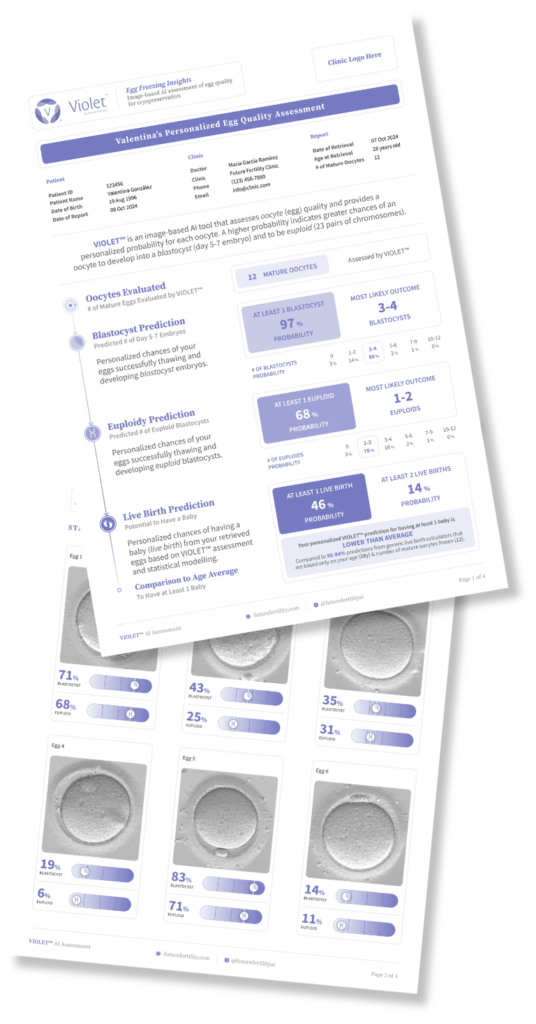
Move beyond age and egg count with the only validated AI tool that helps personalize counselling around oocyte quality and family-building goals.
Provide individualized expectations
Predict blastocyst development potential and personalized live birth probability, benchmarked against age-based estimates.
Predict blastocyst development potential and personalized live birth probability, benchmarked against age-based estimates.
Support proactive cycle planning
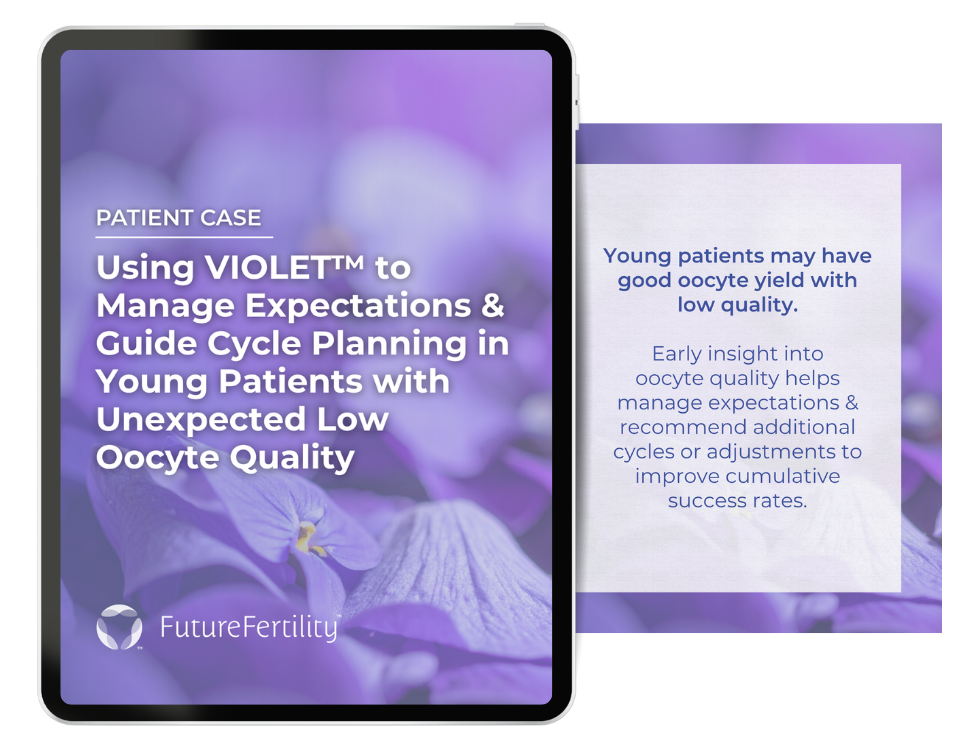
Identify unexpected oocyte quality trends earlier and inform evidence-based recommendations regarding additional retrieval cycles.
Identify unexpected oocyte quality trends earlier and inform evidence-based recommendations regarding additional retrieval cycles.
Create a tangible record for the future
Provide patients with high-resolution oocyte images and objective documentation of their egg freezing cycle.
Provide patients with high-resolution oocyte images and objective documentation of their egg freezing cycle.

MANAGING EXPECTATIONS AND GUIDING TREATMENTS FOR IVF-ICSI PATIENTS
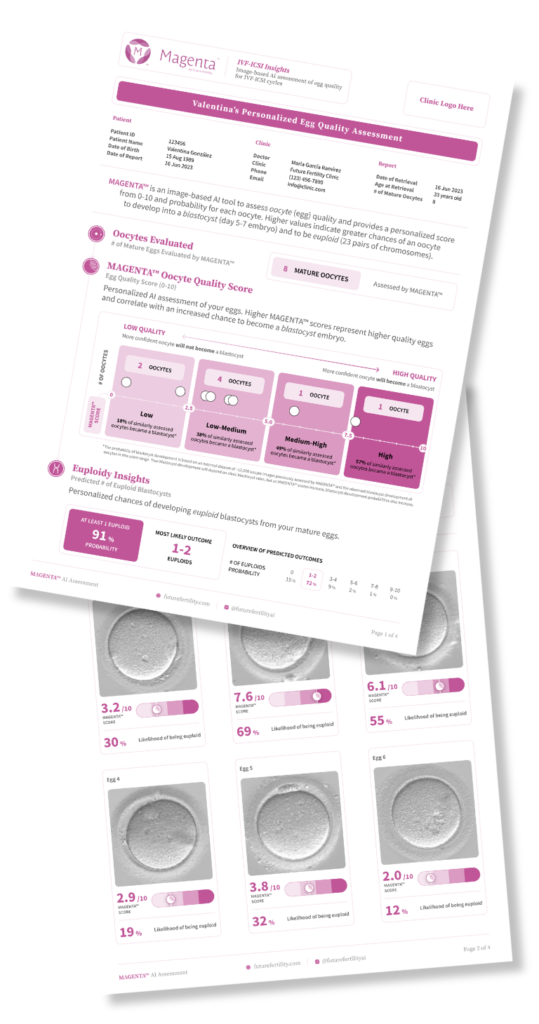
Add a new layer of intelligence to IVF cycles with AI-powered oocyte quality scores that help explain outcomes, guide next steps, and personalize treatment strategies.
Validated against real clinical outcomes
Higher MAGENTA™ scores are independently associated with significantly higher cumulative live birth rates (OR 1.55; AUC 0.691).
Cimadomo et al., Human Reproduction, August 20251
Higher MAGENTA™ scores are independently associated with significantly higher cumulative live birth rates (OR 1.55; AUC 0.691).
Cimadomo et al., Human Reproduction, August 20251
Understand oocyte impact on cycle outcomes
Identify whether oocyte quality may be influencing IVF results, providing a data-backed foundation for counselling beyond assumptions.
Identify whether oocyte quality may be influencing IVF results, providing a data-backed foundation for counselling beyond assumptions.
Support proactive patient counselling
Set realistic expectations for poor prognosis patients and provide additional context when outcomes differ from age or yield-based estimates.
Set realistic expectations for poor prognosis patients and provide additional context when outcomes differ from age or yield-based estimates.
Guide future treatment decisions
Inform targeted adjustments in protocols, additional testing, and broader cycle strategies based on objective oocyte quality insights.
Inform targeted adjustments in protocols, additional testing, and broader cycle strategies based on objective oocyte quality insights.

Transforming donor programs with AI-driven insights
Bring objective oocyte quality insights into donor egg programs to optimize distribution, strengthen quality assurance, and improve transparency based on expected blastocyst outcomes.

SMARTER DONOR OOCYTE DISTRIBUTION POWERED BY OBJECTIVE INSIGHTS
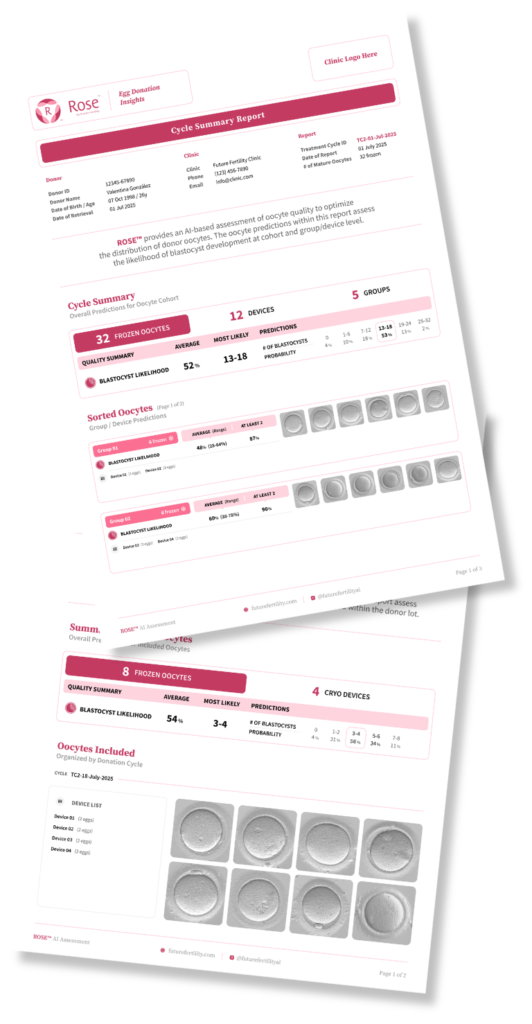
Purpose-built for donor egg programs and co-developed with embryologists to support real-world donor oocyte workflows.
“…being able to evaluate the quality of the available oocyte cohort accurately and in real time would increase the reliability of outcomes,
allow an adjustment of cycles in line with the recipient’s expectations, and streamline the management of oocyte banks.”
Commentary from Gardner et al.,
RBMO, April 20262
Commentary from Gardner et al.,
RBMO, April 20262
Optimize oocyte distribution
Use AI-powered quality insights to support smarter allocation strategies aligned with expected outcomes.
Use AI-powered quality insights to support smarter allocation strategies aligned with expected outcomes.
Strengthen quality assurance
Create greater confidence in donor lot quality with objective assessment, standardized reporting, and data-backed quality benchmarks.
Create greater confidence in donor lot quality with objective assessment, standardized reporting, and data-backed quality benchmarks.
Increase transparency between teams
Provide objective insights that support communication between donor banks, clinics, and recipient programs.
Provide objective insights that support communication between donor banks, clinics, and recipient programs.
Customize ROSE™ to your workflow
Compatible with fresh and frozen cycles, flexible allocation strategies, and donor programs of
different models and sizes.
Globally validated oocyte quality intelligence, powered by the industry’s largest oocyte dataset.
Published manuscripts
0
Book chapters
0
Validation abstracts
0
+
Validation partners
0
+
More accurate than human assessment
In four validation studies, VIOLET™ outperformed all 50 embryologists from 15 different IVF clinics in predicting blastocyst development of mature oocytes with an average relative increased accuracy of 20.2%.3,4
In four validation studies, VIOLET™ outperformed all 50 embryologists from 15 different IVF clinics in predicting blastocyst development of mature oocytes with an average relative increased accuracy of 20.2%.3,4
Consistent results
When presented with the same oocyte image later on, VIOLET™ achieved a 100% repeatability rate (vs 81.4% for embryologists).3
When presented with the same oocyte image later on, VIOLET™ achieved a 100% repeatability rate (vs 81.4% for embryologists).3
Large-scale studies show significant correlation with blastocyst development, quality and ploidy status
Blastocyst formation increased stepwise across MAGENTA™ score groups, from 19% in the lowest group to 52% in the highest (p<0.001). Higher scores were also observed in oocytes that produced higher-quality vs lower-quality blastocysts (6.3 vs. 5.8; p<0.001), and in those resulting in euploid vs aneuploid blastocysts (7.0 vs. 6.6; p<0.001).5-7
These findings underscore the biological contributions of oocyte quality on downstream developmental events.
Blastocyst formation increased stepwise across MAGENTA™ score groups, from 19% in the lowest group to 52% in the highest (p<0.001). Higher scores were also observed in oocytes that produced higher-quality vs lower-quality blastocysts (6.3 vs. 5.8; p<0.001), and in those resulting in euploid vs aneuploid blastocysts (7.0 vs. 6.6; p<0.001).5-7
These findings underscore the biological contributions of oocyte quality on downstream developmental events.
Validated on donor oocytes
In a retrospective study of 18,055 MII oocytes across 11 clinics, ROSE™ significantly outperformed random assignment in assembling donor cohorts (with respect to blastocyst yield), while reducing
lot-to-lot variability in blastocyst output (p<0.01 for all conditions).8
In a retrospective study of 18,055 MII oocytes across 11 clinics, ROSE™ significantly outperformed random assignment in assembling donor cohorts (with respect to blastocyst yield), while reducing
lot-to-lot variability in blastocyst output (p<0.01 for all conditions).8
Use oocyte quality as a lab KPI to inform a clearer picture of clinic performance.
Our new
Clinic Insights
dashboard gives your clinic clear, centralized visibility into your clinic's oocyte quality trends, so you can understand performance over time.
Clinic Insights
dashboard gives your clinic clear, centralized visibility into your clinic's oocyte quality trends, so you can understand performance over time.
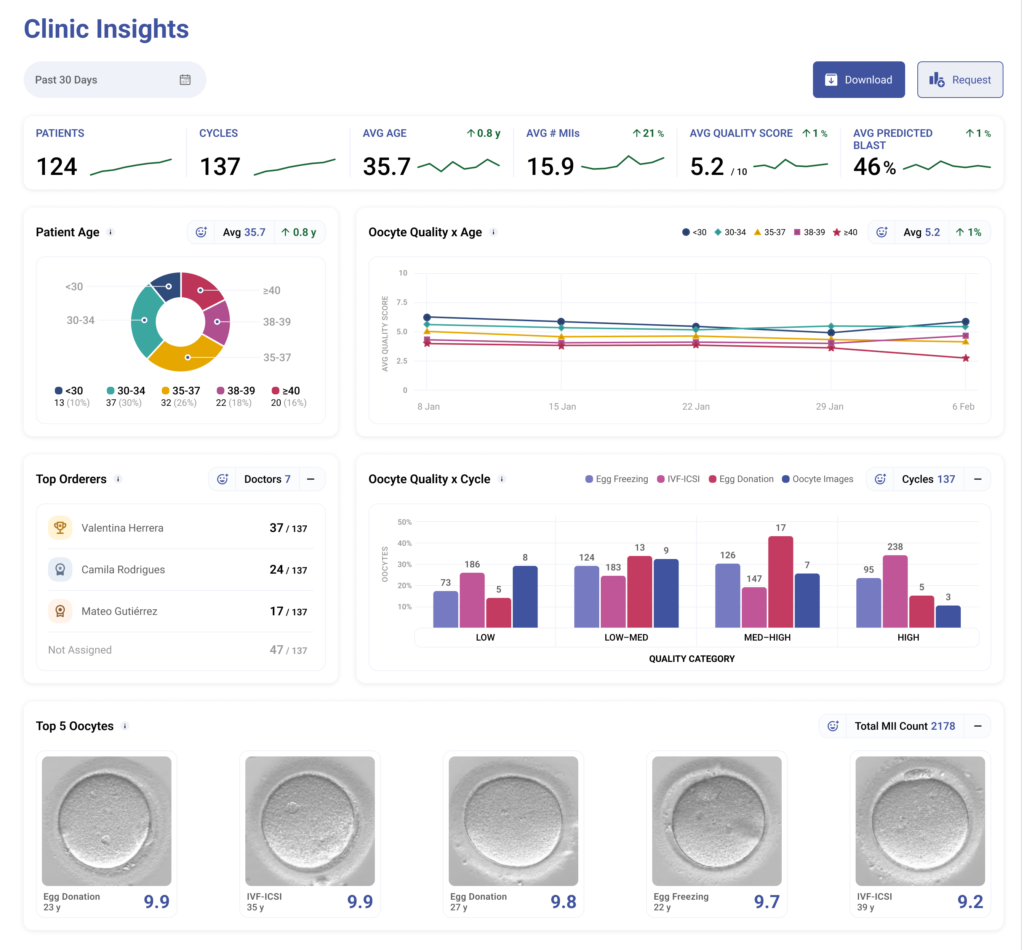
Evaluate oocyte quality scores across all managed cycles to discover clinical outcome drivers.
Visualize lab throughput and oocyte quality trends across your clinic.
Generate snapshots for internal reporting with no added manual work.
Compare across patient groups and trends, without exposing patient-level data.
Explore aggregate,
clinic-level oocyte quality insights and export ready-to-share reports.
clinic-level oocyte quality insights and export ready-to-share reports.
Monitor use of VIOLET™, MAGENTA™, and ROSE™, to support adoption and training opportunities.
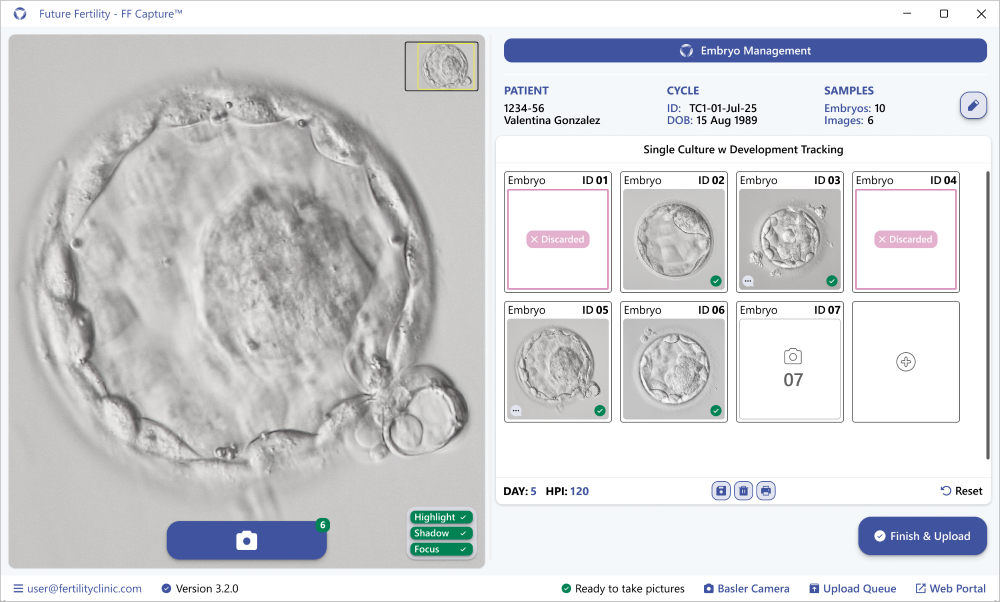
Track and manage embryos with our newest feature.
Use the same simple imaging workflows to track embryo development, manage inventory, and create patient-friendly reports.
Capture embryo images
at every stage of development
Use FF Capture™ or your timelapse integration to document fresh and frozen embryos.
Use FF Capture™ or your timelapse integration to document fresh and frozen embryos.
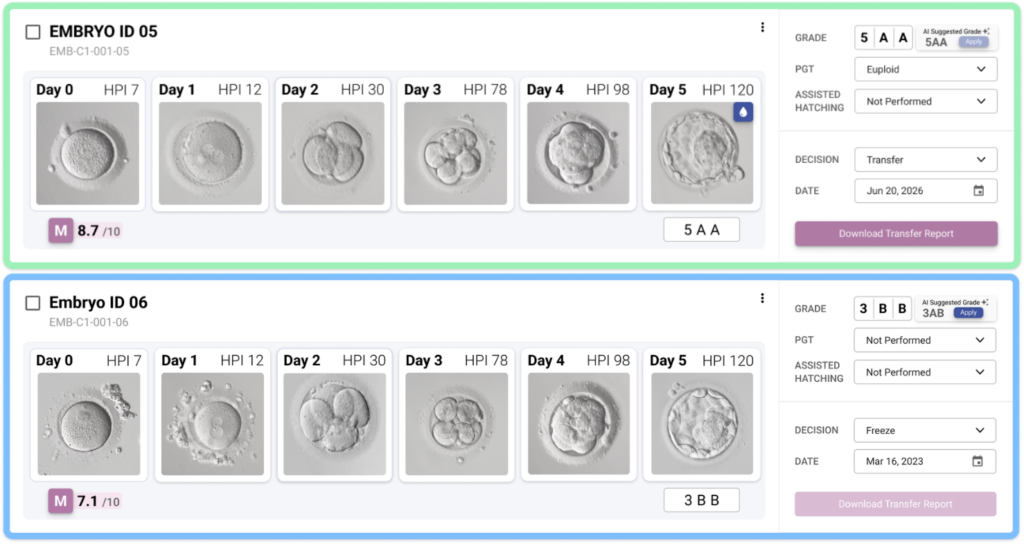
Review and manage development timelines
Automatically generated embryo timelines allow you to review embryo growth, annotate lab outcomes, and support key decisions in one place.
Automatically generated embryo timelines allow you to review embryo growth, annotate lab outcomes, and support key decisions in one place.
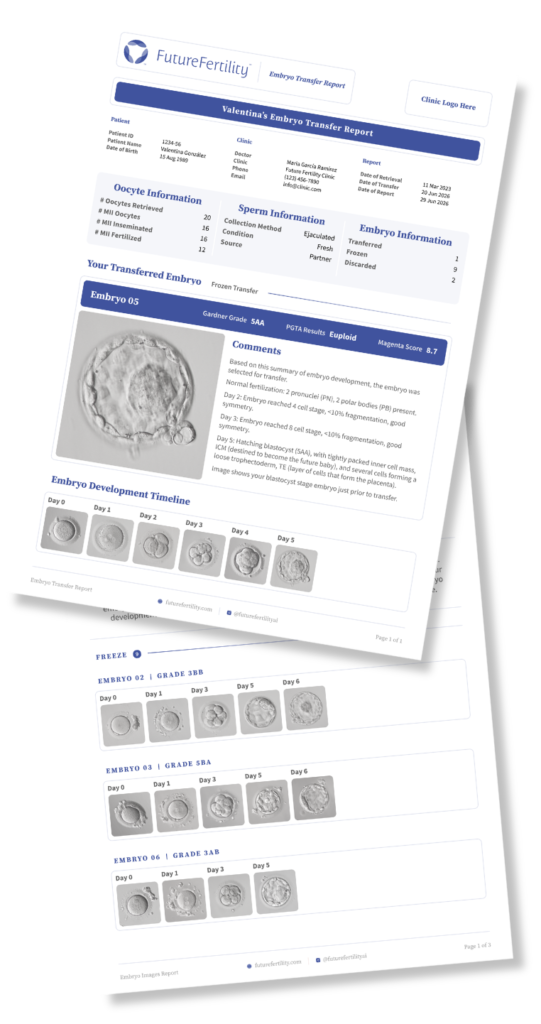
Create multiple report types in <30 seconds
Embryo Transfer Report
shows the development narrative for the selected embryo and gives patients peace of mind with a
tangible take-home keepsake.
Embryo Inventory Report
creates a record of frozen embryos for the lab and patient to enable future decision making.
READY FOR A DEMO?
Get in touch with us
REFERENCES:
- D. Cimadomo, V. Badajoz, M. Hebles, L. Mifsud, C. Urda, T. Sánchez, A. Sánchez, C. Ortega, J. Ávila, C. Mariné, N. Mercuri, J. Fjeldstad, A. Krivoi, D. Nayot, L. Rienzi. 2005. Artificial intelligence-based donor oocyte quality assessment moderately improves the prediction of blastocyst development: a first step towards higher personalization in the management of egg donation treatments. Human Reproduction, Volume 40, Issue 10, October 2025, Pages 1886–1892. Published: August 4, 2025. (Click to access)
- D.K. Gardner, H.C. O’Neill, B. Balaban, M. Meseguer, T. Freour, L. Rienzi. Oocyte quality in the era of AI: integration of morphology, metabolic activity and time-lapse imaging. Reproductive Biomedicine Online, Volume 52, Issue 4, 105363, April 2026. (Click to access)
- D. Nayot, J. Meriano, R. Casper, A. Krivoi. An oocyte assessment tool using machine learning: Predicting blastocyst development based on a single image of an oocyte. Oral Presentation – 36th Annual Meeting of ESHRE – Copenhagen 2020.(Click to access)
- A. Campbell, D. Nayot, A. Krivoi, A. Barrie, K. Jordan, L. Jenner, L. Nice, C. Miralles, S. Barlow, L. Best, Y. Lodge, R. Smith. Independent Assessment Of An Artificial Intelligence-Based Image Analysis Tool To Predict Fertilisation And Blastocyst Utilisation Potential Of Oocytes, And Comparison With Ten Expert Embryologists. Fertility Conference 2021. Oral Presentation SP3.5. Fertility 2021 Conference Abstracts, p.14. (Click to access)
- N. Mercuri, J. Fjeldstad, A. Krivoi, J. Meriano, D. Nayot. A non-invasive, 2-dimensional (2D) image analysis artificial intelligence (AI) tool scores mature oocytes and correlates with the quality of subsequent blastocyst development. Oral Presentation – 78th Scientific Congress of the ASRM – Anaheim 2022. (Click to access)
- D. Nayot, N. Mercuri, A. Krivoi, R.F. Casper, J. Meriano, J. Fjeldstad. 2021. A novel non-invasive oocyte scoring system using AI applied to 2-dimensional images. Fertility and Sterility, Sep;21(116), No 3, Supplement, E474, ASRM 2021 Scientific Congress & Expo. (Click to access)
- J. Malmsten, N. Zaninovic, N. Mercuri, W. Qi, M. Jaberipour, D. Nayot, Z. Rosenwaks, J. Fjeldstad. Image-based oocyte model predictive of blastocyst development correlates with ploidy status across a broad spectrum of PGT-A indications, accounting for confounding variables. Human Reproduction, Volume 39, Issue Supplement 1, July 2024. (Click to access)
- J. Fjeldstad, M. Morgovsky, E. MacKenzie, S. Corsac, L. Vanzella. ROSE, an artificial intelligence (AI)-supported system for donor oocyte allocation, outperforms random assignment by stratifying donor-aged oocytes by blastocyst development potential. Reproductive Biomedicine Online, Volume 52, Supplement 1, 105567, April 2026. (Click to access)