
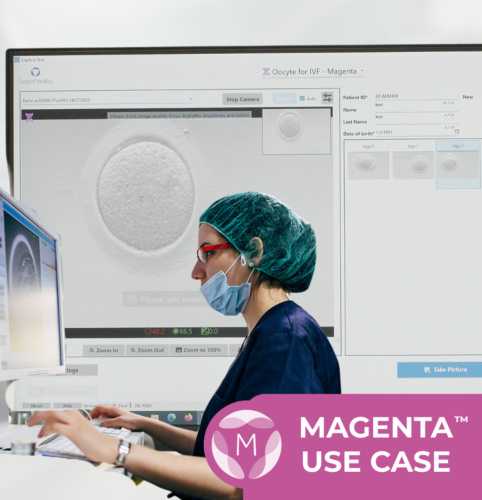
SAMPLE PATIENT CASE:
PATIENT BACKGROUND:
- Age: 34 years
- History: Three consecutive pregnancy losses (7–10 weeks) after 2 IVF cycles and 3 FETs with euploid embryos
- Ovarian reserve: AMH 22 pmol/L → 10–14 MII oocytes per cycle
- Embryology: Multiple high-quality blastocysts generated with each cycle
- PGT-A: Approximately 40% of blastocysts were euploid, which is age-appropriate.
- Sperm: Normal parameters including DNA fragmentation
CLINICAL QUESTION:
Does recurrent pregnancy loss arise from poor oocyte-driven embryo quality (Ref), suboptimal uterine receptivity, or both?
ADDITIONAL INVESTIGATIONS:
🥚 Oocyte and Embryo Data (Seed)
- MAGENTA™ AI scoring of denuded MII oocytes for objective assessment of egg quality.
- Time-lapse embryo monitoring for cleavage timing, multinucleation, and blastocyst formation kinetics.
🌿 Endometrial Data (Soil)
- 3D/Doppler ultrasound to assess endometrial volume, junctional-zone integrity, and uterine blood flow.
- Hysteroscopy to rule out subtle anatomic abnormalities.
- Advanced endometrial biopsy or other functional assays as indicated.
💡 Integrating both seed and soil data helps clinicians identify the true limiting factor, rather than treating both empirically.
CLINICAL MANAGEMENT:
- Optimizing oocyte quality through targeted supplementation and healthy lifestyle habits
- Adjusting stimulation protocols with add-ons focused on improving oocyte quality
- Discussing oocyte donation if low scores persist despite intervention and outcomes remain poor
📊 MAGENTA™ provides objective data to focus treatment on egg quality as the underlying cause of recurrent pregnancy loss and avoid unnecessary uterine investigations or procedures.
2. If MAGENTA™ scores are high/normal with strong morphokinetics alongside a euploid embryo that implanted → Suspect a Soil Issue.
You may consider:
- Proceeding to advanced endometrial biopsy and receptivity testing.
- Reassessing the uterine cavity structure via more advanced imaging or hysteroscopy.
- Tailoring endometrial preparation through individualized FET protocol adjustments.
💡 This ensures attention shifts appropriately to the uterus when the egg is not the limiting factor.
CLINICAL VALUE OF MAGENTA™ IN THIS CASE:
Recurrent pregnancy loss after IVF may stem from either the seed or the soil. By integrating MAGENTA™ AI oocyte scoring with time-lapse embryo monitoring, clinicians gain a quantitative bridge between oocyte quality and embryo performance. This dual-lens approach replaces uncertainty with more clarity guiding personalized, data-driven interventions and helping patients understand where to focus their next steps.
If you’ve found this example helpful in understanding how MAGENTA™ can be incorporated at your clinic or have feedback on other aspects related to your use of Future Fertility’s egg quality assessments, please share it with us at info@futurefertility.com.
Reference regarding the role that oocyte quality plays in embryo quality:
- Female age-related fertility decline. Fertility and Sterility ASRM Committee Opinion No.589, 2014 (reaffirmed 2020). Full text here.
You Might Also Like …
Join our mailing list for dispatches on the future of fertility