

GUEST PERSPECTIVE | PATIENT STORY
How an AI named VIOLET™ helped me trade rose-colored hope and worst-case fear for a clearer view of my fertility odds
I’d wanted to freeze my eggs for a long time, but let’s be honest: U.S. price tags are eye-watering. I couldn’t bring myself to drop a small fortune on what was, at the time, just a “maybe” for my future. But at 38, my perspective shifted. I decided to finally prioritize it—right around the time I learned about high-quality, much more affordable clinics in Spain. That combination of deciding it mattered and finding a path I could actually afford finally got me off the fence.
Before heading overseas, a friend who was deep into embryo science mentioned an innovation called VIOLET™ (an AI tool by Future Fertility that predicts egg viability). I was fascinated, but adoption wasn’t widespread yet, and I ultimately chose a clinic based on the doctor and the price rather than the tech.
It was only a few rounds later, when the clinic offered VIOLET™ as an add-on at the point of sale, that I jumped at the chance. I didn’t view it as a silver bullet, but rather as a “best supporting actor” for my journey. Going into my egg freezing journey, I expected two very specific benefits: informed decision-making by having a useful data point, and a personal sense of subjective control in a process where you usually have none.
Three Types of Fertility Journeys
The thing nobody tells you before you start injecting hormones into your stomach is that you have no idea what kind of path you’re on until you’re already walking it. After going through it myself, I’ve realized most women fall into one of three categories:
- The Sprinters: Usually younger, they walk in, do one round, get a bumper crop of eggs, and cross the finish line smiling.
- The Marathoners: For them, the science is straightforward, but their bodies take a bit longer. It’s a slow and steady climb that requires multiple rounds to hit their target.
- The Mysteries: These are the ones whose results simply don’t add up. Their bloodwork looks great, but the outcome leaves everyone scratching their heads—and doctors often default to blaming “age” because they don’t have a better answer.
You can guess which one you’ll be based on your AMH levels and birth year, but you don’t actually know until you’re in the thick of it.
My Personal Fertility Dashboard
Because the terrain was so unpredictable, I stopped fixating on a single, magical target number. Instead, I built my own personal dashboard. I started tracking three specific metrics to help me go my own distance:
- Number of Rounds: This was the ultimate measure of my physical and financial endurance. It was also the variable I had the most control over.
- Gross Number of Eggs: The raw, net total of eggs safely tucked away in the freezer.
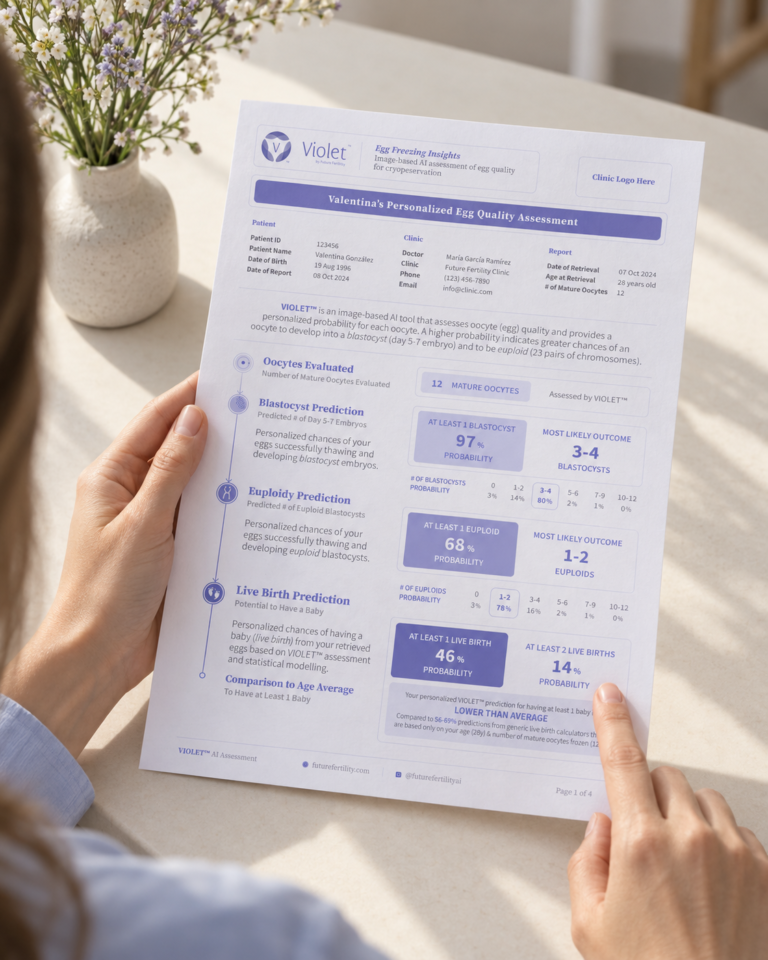
- Effective Eggs: This was my quality-adjusted number, where VIOLET™ came into play. By providing an independent assessment of egg viability, it gave me that useful, baseline data point for informed decision-making. It was just nice to know, of the eggs I actually got, how they looked.
How it worked for me: Paying attention to all of these numbers helped me feel like I was able to make good decisions, especially when my body didn’t cooperate. No matter what kind of journey you’re on, having this clarity allows for authentic, realistic goal-setting and a grounding sense of control.
There was a quieter benefit to this data, too, which fed right into that desire for personal, subjective control. I actually started to enjoy running little lifestyle experiments. Was my VIOLET™ report a little better in the round where I was super disciplined about taking CoQ10? Who knows! None of this was precise or clinically validated, but giving myself a way to feel like an active participant—rather than just a passenger in my own body—was its own kind of medicine.
From "Mystery" Back to "Marathoner"
I fully expected to be a marathoner, but after a few rounds, it became clear I was a mystery. Each time, we were retrieving far fewer mature eggs than the doctors expected. Several specialists expressed utter befuddlement, claiming they hadn’t seen a case quite like mine and attributing it mostly to “age.”
But I wasn’t willing to stop there—remember metric #1? I still had the endurance for more rounds. So, I took my data and went to a clinic that specializes in older women, where my results improved dramatically. I essentially graduated from being a mystery back into a predictable marathoner.
This pivot is where I encountered a third benefit of VIOLET™—one that completely surprised me. For those who end up doing many rounds, the tool can actually help confirm or disconfirm decisions on protocol optimization. If you turn out to be a mystery, your clinic may find additional value in these reports as secondary diagnostic inputs.
My new medical team suspected my previous clinic had been retrieving my eggs too late for my specific body, and the VIOLET™ data helped corroborate exactly what they were seeing. It showed us that an egg that was clearly degenerating and unviable came from the exact round where I’d been on stimulation medications the longest. Knowing about that unviable egg early on let me plan around an honest number, and that bit of extra confirmation ultimately helped us settle on the right cycle length and medication amounts for me.
The Ultimate Takeaway
If I could pass along one piece of advice to anyone looking at a fridge full of hormone shots, it’s this: The real skill in egg freezing is goal-setting, and the right metrics do double duty. They help you manage your expectations, and they tell you when it’s time to pivot. Decide what you are optimizing for, track a few honest numbers, and let them guide how you spend your energy, your money, and your time. If your body refuses to follow the textbook, those numbers will be the exact tools you need to advocate for yourself, ask the hard questions, and get a second opinion. Don’t let “age” be the only answer you settle for.
A note from Future Fertility: This article reflects the author’s individual experience and perspective. Fertility outcomes and treatment experiences vary from person to person, and the information shared here should not be considered medical advice. Patients should discuss their individual circumstances and treatment decisions with their fertility care team.
Join our mailing list for dispatches on the future of fertility