
INTRODUCTION:
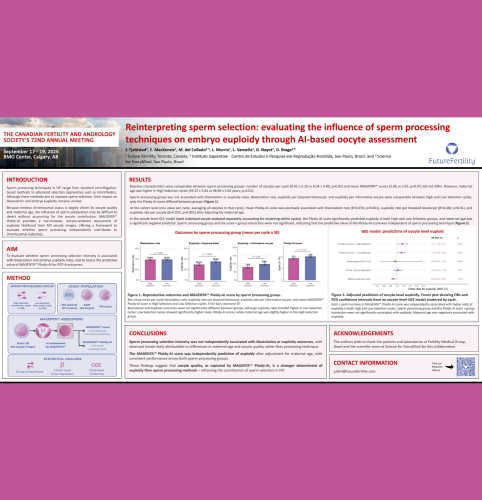
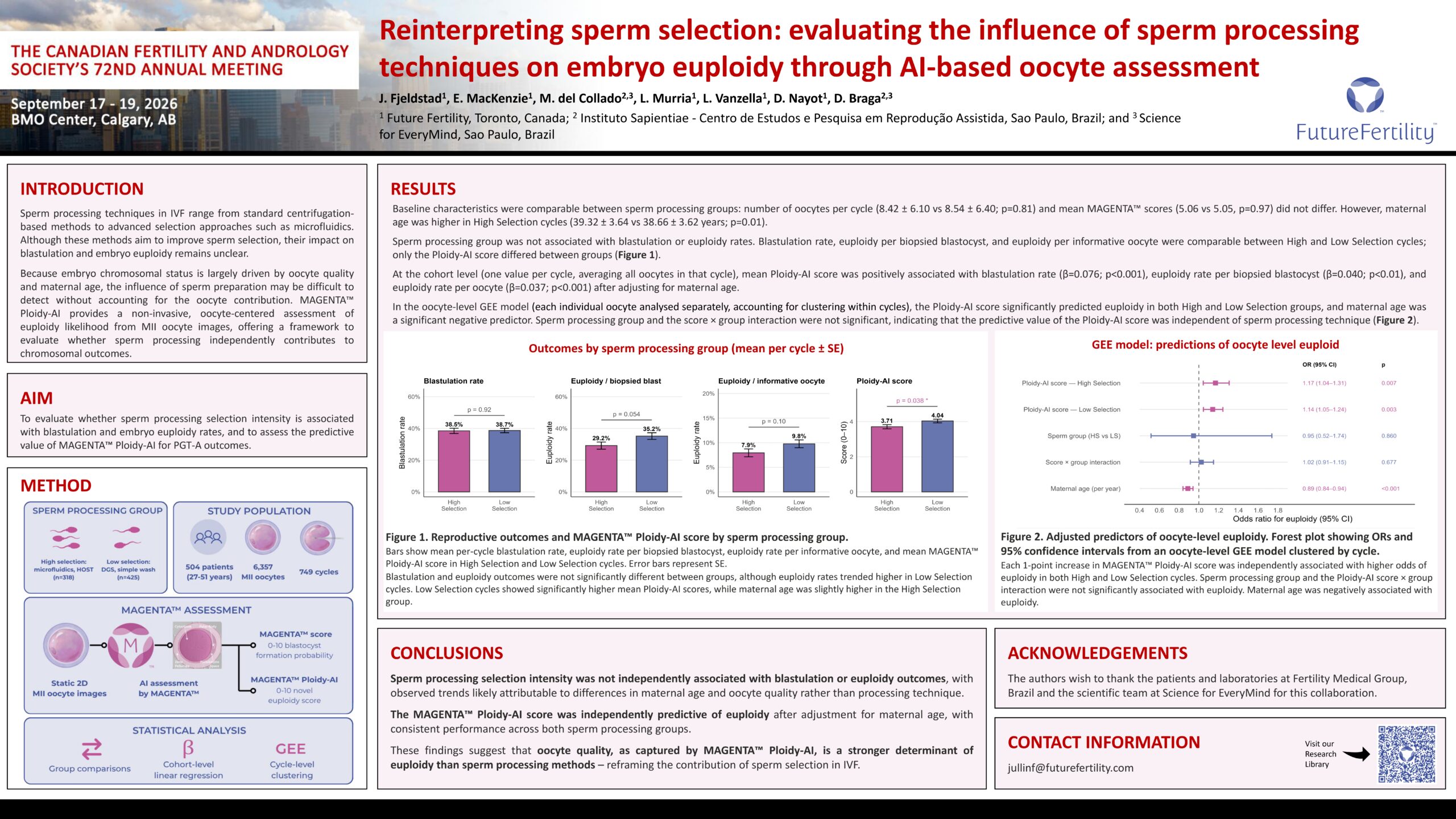
Sperm processing techniques in IVF range from standard centrifugation-based methods to advanced selection approaches such as microfluidics. Although these methods aim to improve sperm selection, their impact on blastulation and embryo euploidy remains unclear.
Because embryo chromosomal status is largely driven by oocyte quality and maternal age, the influence of sperm preparation may be difficult to detect without accounting for the oocyte contribution. MAGENTA™ Ploidy-AI provides a non-invasive, oocyte-centered assessment of euploidy likelihood from MII oocyte images, offering a framework to evaluate whether sperm processing independently contributes to chromosomal outcomes.
AIM:
To evaluate whether sperm processing selection intensity is associated with blastulation and embryo euploidy rates, and to assess the predictive value of MAGENTA™ Ploidy-AI for PGT-A outcomes.
METHODS:
This retrospective study analyzed static, 2D images, obtained from EmbryoScope time-lapse incubators, of 6,357 MII oocytes from 504 patients (27-51 in 749 IVF-ICSI cycles. Surgically retrieved sperm were excluded from analysis. Cycles were categorized into two groups based on sperm processing technique: “High Selection” cycles (HS; n=318), comprising advanced methods including microfluidics and hypoosmotic swelling tests, and “Low Selection” cycles (LS; n=425), including techniques such as density gradient centrifugation and simple wash. Six cycles (50 oocytes) with insufficient information on sperm processing technique were excluded from the comparative analysis. Oocyte images were assessed by MAGENTA™, which generated objective scores (0–10) reflecting the probability of blastocyst formation, and MAGENTA™ Ploidy-AI, which generated a novel ploidy score (0-10). Chromosomal status was determined from embryo biopsy via PGT-A (562 euploid, 915 aneuploid). Group comparisons, cohort-level linear regression adjusted for maternal age, and oocyte-level generalized estimating equations (GEE) clustered at the cycle level were used to evaluate the association between AI-derived scores and reproductive outcomes.
RESULTS:
Baseline characteristics were comparable between sperm processing groups: number of oocytes per cycle (8.42 ± 6.10 vs 8.54 ± 6.40; p=0.81) and mean MAGENTA™ scores (5.06 vs 5.05, p=0.97) did not differ. However, maternal age was higher in High Selection cycles (39.32 ± 3.64 vs 38.66 ± 3.62 years; p=0.01).
Sperm processing group was not associated with blastulation or euploidy rates. Blastulation rate, euploidy per biopsied blastocyst, and euploidy per informative oocyte were comparable between High and Low Selection cycles; only the Ploidy-AI score differed between groups (Figure 1).
At the cohort level (one value per cycle, averaging all oocytes in that cycle), mean Ploidy-AI score was positively associated with blastulation rate (β=0.076; p<0.001), euploidy rate per biopsied blastocyst (β=0.040; p<0.01), and euploidy rate per oocyte (β=0.037; p<0.001) after adjusting for maternal age.
In the oocyte-level GEE model (each individual oocyte analysed separately, accounting for clustering within cycles), the Ploidy-AI score significantly predicted euploidy in both High and Low Selection groups, and maternal age was a significant negative predictor. Sperm processing group and the score × group interaction were not significant, indicating that the predictive value of the Ploidy-AI score was independent of sperm processing technique (Figure 2).
CONCLUSIONS:
Sperm processing selection intensity was not independently associated with blastulation or euploidy outcomes, with observed trends likely attributable to differences in maternal age and oocyte quality rather than processing technique.
The MAGENTA™ Ploidy-AI score was independently predictive of euploidy after adjustment for maternal age, with consistent performance across both sperm processing groups.
These findings suggest that oocyte quality, as captured by MAGENTA™ Ploidy-AI, is a stronger determinant of euploidy than sperm processing methods – reframing the contribution of sperm selection in IVF.
ACKNOWLEDGEMENTS:
The authors wish to thank the patients and laboratories at Fertility Medical Group, Brazil and the scientific team at Science for EveryMind for this collaboration.
You Might Also Like …
Join our mailing list for dispatches on the future of fertility