

If you’re thinking about freezing your eggs in your 30s, you’ve probably wondered—how many eggs are enough?
You may have seen egg freezing calculators or estimates based on age. But freezing your eggs at 31 can look quite different from freezing them at 38. And even women of the same age can have different reproductive potential.
So, is there really a number you should aim for?
Egg freezing is about more than just a number—egg quality matters, too
A new 2026 study published in Human Reproduction Open offers a fresh perspective on this question.¹
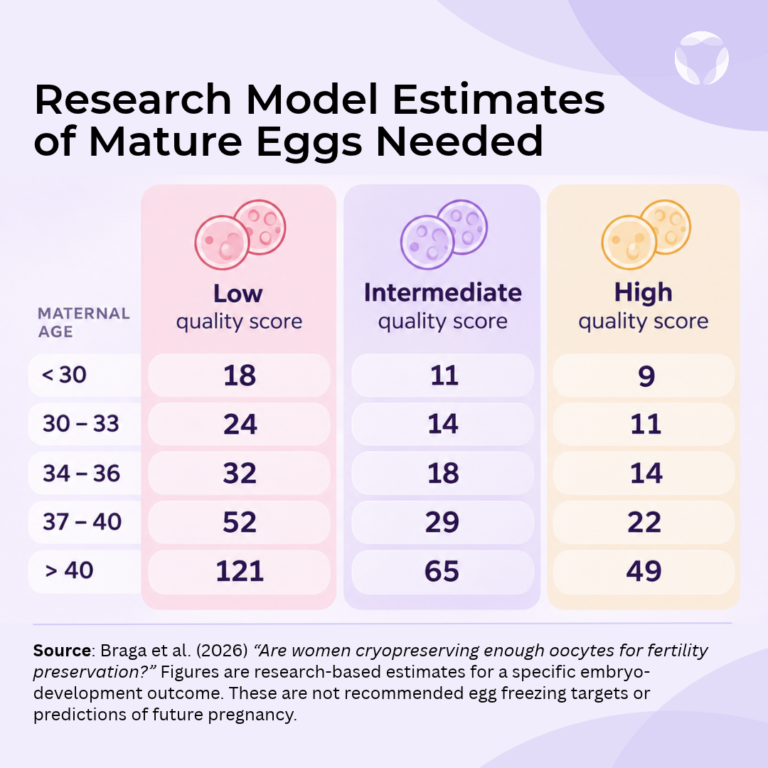
Researchers used AI-derived egg quality scores generated by Future Fertility’s MAGENTA™ technology, along with age-related data, to estimate how many mature eggs might be needed to have a 90% chance of developing at least three chromosomally normal embryos.
What did they discover? The estimates varied considerably, even among women of the same age.
For women aged 34-36, for example, the model estimated that between 14 and 32 mature eggs would be needed to reach the study’s defined embryo outcome, depending on whether their eggs received low, intermediate, or high AI-assessed quality scores.
The researchers also found an interesting trend across the 30s: as women aged, they tended to freeze fewer mature eggs per cycle, while the number estimated to be needed increased.
The bigger takeaway? Age and egg count are important starting points, but AI-derived egg quality insights can provide information about reproductive potential that these traditional measures alone can’t capture. This can support a more personalized approach to egg freezing planning.
What does this mean for your egg freezing plans?
A question that often comes up is whether one egg freezing cycle will be enough.
There’s no universal answer. It depends on your age, ovarian reserve, how many mature eggs you freeze, your desired family size, and other individual factors, especially egg quality.
Historically, fertility specialists have had limited ways to objectively assess egg quality. Now, AI-powered technology is making it possible to have insights into your eggs’ reproductive potential.
Could that information help you decide whether another cycle is worth pursuing?
Another 2026 study published in Human Reproduction explored how egg quality insights from Future Fertility’s VIOLET™ reports were used alongside physician guidance when women were deciding whether to undergo additional egg freezing cycles.2 VIOLET™ uses AI to analyze eggs and provide personalized estimates of the chances of having a baby using those eggs in the future.
Women with more favorable predicted reproductive outcomes were more likely to decide against further cycles, while those with less favorable predictions were more likely to continue.
The findings suggest that egg quality assessments may have a meaningful role in helping women navigate decisions around additional egg freezing cycles.
By offering insights beyond age and egg count alone, VIOLET™ gives women and their fertility specialists additional information to consider when making decisions about their egg freezing plans.
Fertility isn't one-size-fits-all
Your early 30s and late 30s may bring different considerations when it comes to freezing your eggs. But one thing remains true at any age: your fertility journey is individual.
Whether you’re exploring egg freezing for the first time or deciding if another cycle makes sense, this research highlights the value of having more information about your eggs to help you make informed decisions about your future.
Ultimately, it’s not only about how many eggs you freeze. It’s about understanding the egg quality, knowing your options, and making a plan that’s right for you.
Reference
1 Braga et al., 2026 — “Are women cryopreserving enough oocytes for fertility preservation?,” Human Reproduction Open. The study used IVF data to model egg requirements and compared these estimates with egg freezing outcomes. The estimates have not been validated as individualized predictions for egg freezing patients.
2 Riqueros Arevalo et al., 2026 — “From Prediction to Decision: Patient Choices Following AI-Based Non-Invasive Oocyte Assessment in Elective Fertility Preservation,” Human Reproduction. Abstract presented at the European Society of Human Reproduction and Embryology (ESHRE) 2026 Annual Meeting.
You Might Also Like …
Join our mailing list for dispatches on the future of fertility