
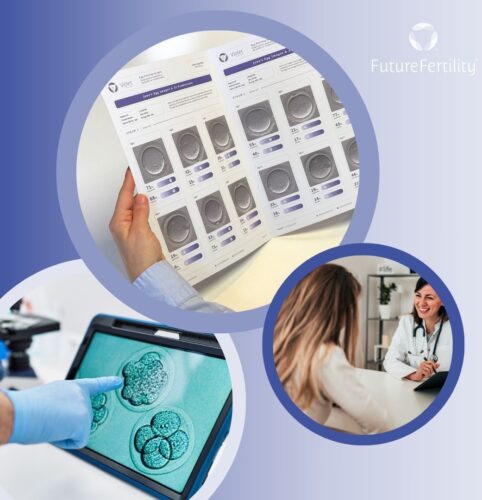
If you’ve been researching fertility treatment, you’ve likely noticed that AI has entered the chat. More clinics are integrating artificial intelligence tools into their practice, which has patients asking questions like — How is AI used in IVF? Can AI predict egg quality? Does AI replace my fertility doctor?
In this AI in Fertility: Explained blog series, we’ll be diving into the what, why, and how of AI in fertility treatment. Keep reading to learn what AI can (and can’t) do, and how it can help you feel more informed along the way.
What AI Looks Like in the Fertility Clinic
In fertility care, AI isn’t a single machine or robot making decisions for you. It’s a set of smart tools that analyze large amounts of data and turn that information into insights your care team can use to support more personalized decisions. AI helps by identifying patterns in lab images, across hormone levels, and among trends from thousands of real fertility treatment experiences.
Within fertility, AI’s biggest role is helping reduce uncertainty by adding new layers of objective, data-driven information, grounded in real patient outcomes. So how does this actually show up during fertility treatment?
How AI Is Used in IVF and Egg Freezing
AI is already being used in many parts of the IVF and egg freezing process. Here’s how it can support different stages:
🥚 Egg Quality Assessment
Using image analysis, non-invasive AI tools, like VIOLET™ for egg freezing and MAGENTA™ for IVF, can provide insight into egg quality and the potential of individual eggs becoming a blastocyst – even before fertilization.
🧬 Sperm Selection
AI can analyze sperm movement and shape in ways that go beyond what the human eye can track, helping labs identify sperm with stronger characteristics.
🌱 Embryo Selection
AI tools can help labs rank embryos based on patterns linked to successful development, supporting decisions about which embryo to transfer or freeze.
💉 Stimulation & Injection Timing
By analyzing how your body responds to medication, AI can help inform dosing and timing decisions for more individualized care plans.
📊 Pre-Treatment Planning
Based on outcomes from similar patients, AI can help set more realistic expectations before treatment even begins.
🧭 Customized Treatment Paths
Data-driven predictions can support more personalized recommendations — whether that’s adjusting protocols or planning future cycles.
🧪 Lab Workflow & Consistency
AI helps improve objectivity and consistency in the lab, supporting standardized assessments across cycles and patients.
🔍 Diagnosis & Prediction
With image or hormone data, AI helps detect signs of fertility-related conditions like PCOS, poor ovarian response, or endometriosis, supporting earlier conversations and planning.
What AI Doesn’t Do
It’s important to be clear about what AI does — and doesn’t — do in fertility care. AI does not guarantee outcomes, and it doesn’t make decisions on its own.
Instead, it provides additional information that helps you and your care team:
- Ask better questions
- Set clearer expectations
- Make more informed choices together
For many people, the hardest part of fertility treatment isn’t the injections or appointments — it’s the uncertainty. Not knowing how your body will respond, or what outcomes to expect, can be emotionally exhausting.
AI helps reduce that uncertainty by adding clarity where there was once only guesswork. By supporting more personalized conversations and offering insights tailored to your unique situation, AI can make the journey feel a little less overwhelming — and a lot more informed.
If you’re considering IVF or egg freezing, talk with your clinic how AI-driven insights can support your treatment planning and decisions.
And if you’re looking for a clinic that offers egg quality insights as part of care, explore our partner clinic network to get started.

You Might Also Like …
Join our mailing list for dispatches on the future of fertility