
KEY QUESTION
Routine oocyte dysmorphism documentation is common in IVF laboratories (Reference: The Istanbul Consensus update: a revised ESHRE/ALPHA consensus on oocyte and embryo static and dynamic morphological assessment† ‡ – PubMed). However, does it meaningfully change clinical decisions, improve outcomes, or justify the time required during a high-pressure ICSI workflow?
For most oocytes, likely not.
CONTEXT:
Oocyte morphology has traditionally been used as a surrogate for egg quality, but routine dysmorphism assessment remains subjective, inconsistently applied, and often weakly associated with reproductive outcomes.
As emphasized by Gardner et al. (2026): [Reference: Oocyte quality in the era of AI: integration of morphology, metabolic activity and time-lapse imaging – Reproductive BioMedicine Online] “…except for grossly abnormal features, such as giant eggs, oocyte morphology is not strongly associated with clinical outcomes.”
MAGENTA™ offers an alternative approach: capture a standardized oocyte image, generate an objective AI-based quality score, and reserve morphology documentation for situations where it is clinically relevant.
This shifts assessment from subjective description toward reproducible, image-based, outcome-linked evaluation.
CURRENT CHALLENGE
The updated ESHRE/ALPHA Istanbul Consensus (2025) describes the characteristics of an “ideal” oocyte, (Reference: The Istanbul Consensus update: a revised ESHRE/ALPHA consensus on oocyte and embryo static and dynamic morphological assessment† ‡ – PubMed) but there remains no standardized, validated scoring system that combines dysmorphisms into a reproducible and clinically meaningful framework. (Reference: Predictive value of oocyte morphology in human IVF: a systematic review of the literature – PubMed)
This creates several problems:
- Application varies substantially between embryologists.
- Interpretation remains subjective.
- Descriptors such as “granular,” “dark,” or “large perivitelline space” are not consistently applied.
- Dysmorphisms have weak or inconsistent associations with outcomes.
- All mature MII oocytes usually proceed to insemination regardless of morphology, except in rare cases such as giant oocytes.
The result is high effort with limited clinical signal.
Routine dysmorphism documentation rarely changes management, adds workflow burden during ICSI, and generates data that are difficult to standardize or use for broader analysis.
MAGENTA™ does not determine whether an MII oocyte proceeds to insemination. Instead, it converts images into standardized, reproducible data while preserving the visual record for later review.
Potential advantages include:
- Reduced documentation burden
- Time savings
- Image archiving
- Quality monitoring and benchmarking
- Improved patient counselling
Why this matters Operationally
The denudation and ICSI window is time-sensitive. Embryologists are already balancing workflow, timing, handling conditions, image review, insemination, documentation, and communication.
Adding routine dysmorphism comments creates work, but not necessarily value.
Typical workflow:
- Oocytes retrieved and denuded
- MII oocytes identified
- MII oocytes proceed to ICSI
- Dysmorphisms documented during ICSI
In most cases, documentation does not alter management.
At the same time, many laboratories do not consistently archive standardized oocyte images, meaning the most information-rich source—the image itself—is often not preserved for review, quality assessment, or future analysis.
A better default workflow
Rather than manually describing all visible dysmorphisms:
Capture the image → Automatically score with MAGENTA™ → Document only when clinically relevant
This approach:
- Preserves the visual record
- Reduces low-value manual documentation
- Allows morphology review when needed
- Creates standardized, scalable data
MAGENTA™ insight: From description to measurement
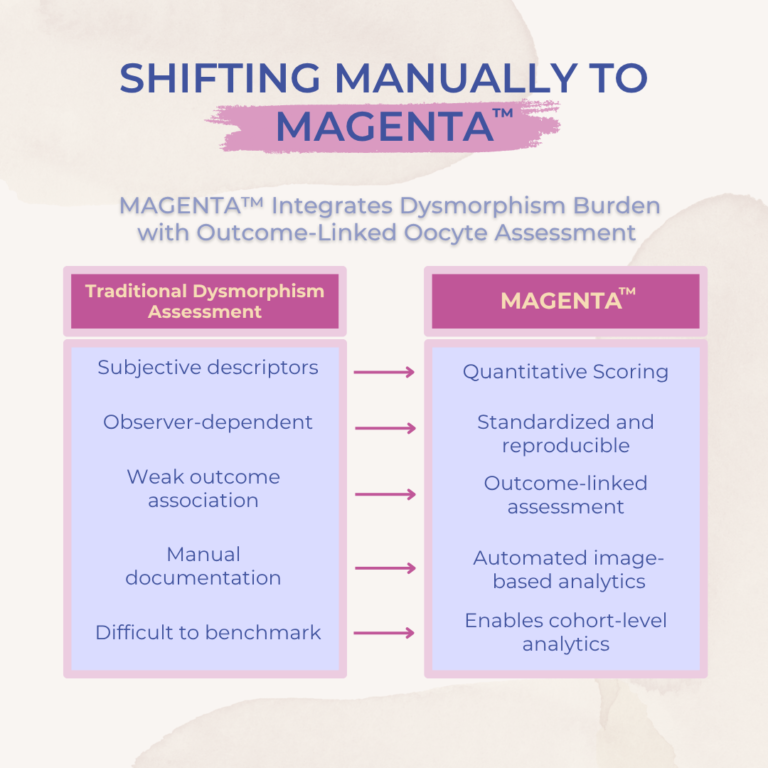
Traditional dysmorphism assessment asks: “What does this oocyte look like?“
MAGENTA™ asks: “What does this image suggest about developmental potential?“
MAGENTA™ identifies image-based patterns associated with downstream development, including visible dysmorphisms and additional features that may not be consistently recognized by human observers.
MAGENTA™ and dysmorphism burden
MAGENTA™ scores consistently show strong associations with blastocyst development and are influenced by both specific dysmorphisms and the total number of dysmorphic features present. A single feature may be difficult to interpret. Multiple features may matter more.
In our studies, while certain dysmorphisms were linked to higher or lower scores respectively, the cumulative effect of multiple dysmorphisms had the greatest impact on the MAGENTA score. Importantly, MAGENTA differentiated blastocyst-forming oocytes regardless of dysmorphism presence, supporting a more objective, outcome-linked approach to oocyte assessment.
MAGENTA™ does not ignore morphology; it converts morphology into standardized, scalable, outcome-linked information.
Clinical and Operational implications
Reduces time
- Removes non-essential documentation
- Frees embryologist capacity
Reduces variability
- Minimizes inter-observer differences
- Standardizes across laboratories
Improves signal
- Replaces weak surrogate markers with outcome-linked data
Enables benchmarking
- Supports cohort and site-level comparisons
Preserves flexibility
- Images remain archived for future review
Recommended lab policy
Routine dysmorphism documentation should not be the default for every oocyte.
A more efficient approach:
- Capture standardized oocyte images
- Use MAGENTA™ for objective assessment
- Document dysmorphisms only when clinically relevant or required
- Preserve images as the primary record
- Use MAGENTA™ outputs for benchmarking, quality monitoring, and counselling
This is not about ignoring morphology. It is about efficiently evaluating morphology in a more objective, reproducible, and clinically useful way.
Capture the image. Apply MAGENTA™. Comment only when the finding matters.
If you’ve found this example helpful in understanding how MAGENTA™ can be incorporated at your clinic or have feedback on other aspects related to your use of Future Fertility’s egg quality assessments, please share it with us at info@futurefertility.com.
You Might Also Like …
Join our mailing list for dispatches on the future of fertility